Client Management System: A security-first platform for sensitive data.
Ignium’s Client Management System (CMS) supports providers working under ACC’s sensitive claims contracts. Since taking over the platform, Bonnici has maintained and improved it, as well as putting clear release processes in place, so all updates are secure and predictable.
- Client
- Ignium
- Industry
- Healthcare
- What we did
- Security hardening, ongoing feature development, platform maintenance
- Timeline
- Ongoing from 2025
6.3m
billable sessions recorded
185000+
clients managed
110
improvements shipped across 14 releases
The challenge
Keeping providers supported and patients protected
Providers working under ACC’s sensitive claims contracts support some of the most vulnerable people in our communities. They rely on the CMS every day to manage cases, track client information and get paid. That information is deeply personal, and clients trust that it stays private.
The platform has to be there whenever providers need it. If it goes down or a release breaks something, they can’t access case information or invoice on time. For clients, the stakes are even higher. A single security incident could expose their most sensitive details.
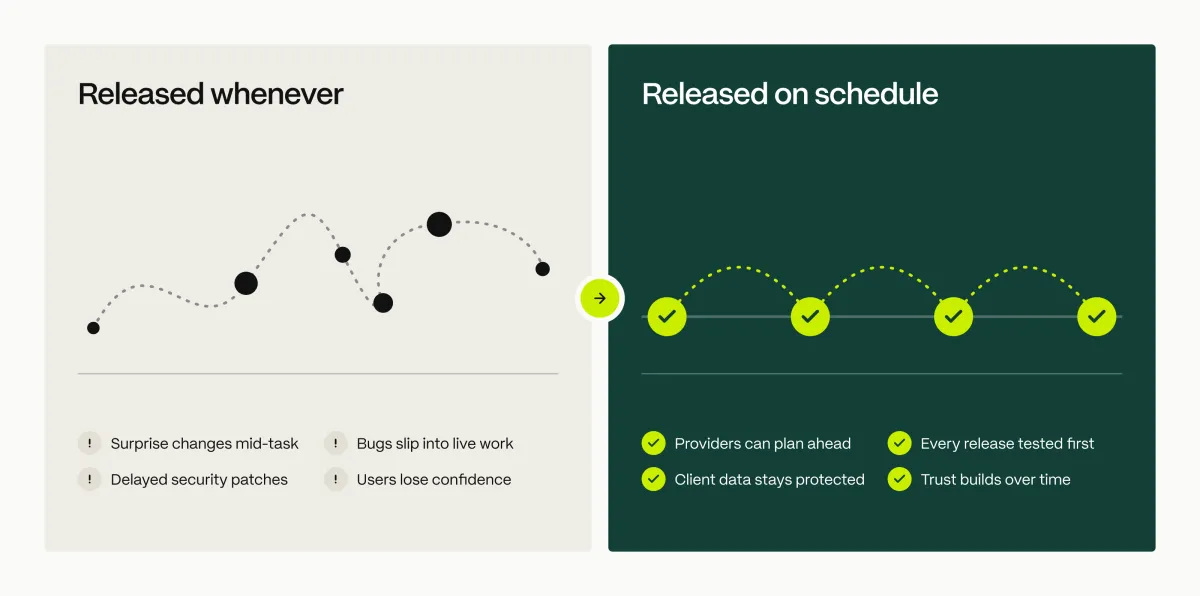
Updates were also made ad hoc. With no regular release schedule, providers often didn’t know when changes were coming or what had changed, which made it harder to plan their work and trust the platform.
At the same time, the platform had to keep up with providers’ needs, regular technology upgrades and strict healthcare data and ACC requirements. The challenge was to bring structure to how it evolved, without ever putting clients’ data or care at risk.
The approach
Continuous improvement, with security built into every change
On a platform this sensitive, how we made changes matters as much as what is changed.
A clear, regular release schedule.
We replaced ad hoc updates with a consistent release schedule. Every change is now planned, built, tested, then released on a set date. Providers know what’s coming and when, and Ignium can plan around it with confidence.
A framework for testing and managing risk.
Every update is tested against the same checklist before it goes live, and changes are released in small steps so any issue is easy to spot and fix. Clear processes mean nothing reaches providers by accident, even when the team is moving quickly.
Improvements shaped by provider feedback.
With a solid process in place, we can focus on what makes the biggest difference. We build from provider feedback, prioritising changes that make day-to-day work easier, then ship them through the same tested, scheduled process.
Security and Drupal as the foundation.
Drupal has its own security team that finds problems and releases fixes quickly, and our release process means we can apply them straight away. Detailed permissions, secure backups and constant monitoring sit behind it all. Clear upgrade paths keep the platform current without a costly rebuild, and this year that meant moving it to Drupal 10.
The outcome
A platform providers can count on
Clear expectations that built trust.
Updates now follow a consistent test and deploy schedule, so Ignium and its providers always know what’s coming and when. No more surprise changes or guessing what’s been updated. In the last 12 months, we’ve shipped 110 improvements across 14 planned production releases. That predictability has built real trust in the platform, and in the team looking after it.
A smoother, lower-risk way of working.
We introduced clear frameworks for testing and managing risk, so every change is planned, tested and released the same way. Development runs more smoothly behind the scenes, and the 4,200+ practitioners using the platform each month can keep tracking cases and invoicing ACC without disruption.
1.1+ million records kept safe.
Across 6.3 million billable sessions, every invoice, case note and client detail has stayed secure, with no breaches since we came on board. As healthcare data regulations and ACC requirements have changed, the platform has stayed compliant.
Upgraded to Drupal 10.
This year we moved the platform to Drupal 10, keeping it on a modern, supported version with the latest security protections and a clear path for future upgrades.
We've worked closely with Bonnici for over a year, and they've naturally become our lead developer. With limited time and lots of stakeholders to manage, their fantastic communication and easy planning and scheduling make a real difference.
Ongoing work
Why is a consistent release schedule important for your platform?
A consistent release schedule makes software updates predictable, safer and easier to trust. For platforms that handle sensitive data, poor release management can lead to:
- Unexpected updates. Users find out about changes after they've happened, often mid-task.
- Bugs reaching live users. Without consistent testing before every release, one update can break something people rely on.
- Delayed security patches. Fixes wait for the next big update, leaving known vulnerabilities open for longer.
- Loss of user trust. When updates feel random, people stop relying on the platform.
A clear release process solves this: plan updates on a regular schedule, test every change the same way, and tell users before anything goes live.