How a national police agency now handles 1,000+ submissions a day
We built a custom Drupal platform for a New Zealand national police agency that handles 1,000+ public submissions a day, many of them sensitive and urgent. Every submission goes straight to the right team, securely and with a full audit trail.
- Client
- National Police Agency
- Industry
- Government
- What we did
- Drupal government platform, high-volume form processing, system integration, sensitive data management
- Timeline
- 2024 to 2025
56,000+
charges submitted online, replacing a fully manual process
87%
reduction in computer-aided dispatch handling time
23
purpose-built forms to streamline enquiries
The challenge
How do you get 1,000 sensitive forms a day to the right team, every time?
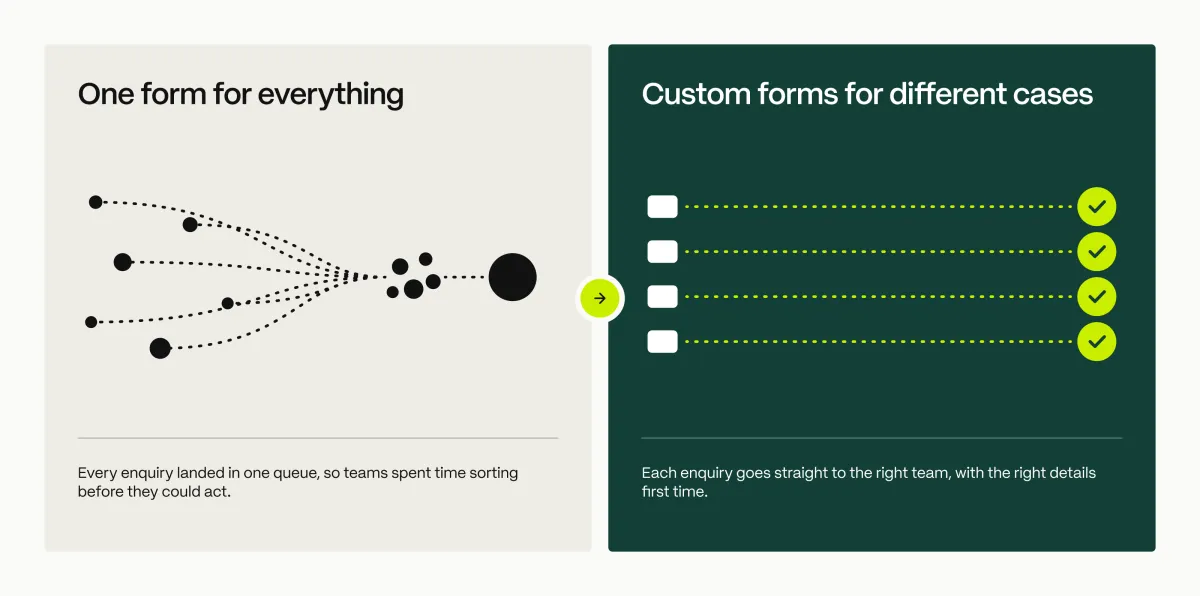
Every day, thousands of people were submitting information to the police agency online. But with limited form options, enquiries bottlenecked, and teams couldn’t manage the volume efficiently.
For a police agency, that’s a public safety risk. Urgent enquiries weren’t being addressed fast enough, and the agency’s internal systems were never designed to communicate with each other. Volumes also spiked whenever a public initiative was publicised.
The agency needed forms that could handle the volume, get each submission to the right team, and meet government accessibility, security and audit requirements.
The approach
What the platform had to get right.
Before building anything, we ran discovery with each group involved. What we uncovered came down to four key requirements that guided the build.
Simple for the public and easy to scale.
Every form had to walk people through one step at a time and only ask what’s relevant. And every form had to be built from reusable blocks, so adding new ones never meant starting from scratch.
Nothing re-keyed so nothing lost.
Every submission had to reach the right team automatically, even though the agency’s systems had never talked to each other. Data had to be encrypted and recorded on the way, and if a system went down, no submission could be lost.
Security without compromise.
Staff should only see what their role requires, with clear rules for how long information is kept. From day one, we held ourselves to the New Zealand Information Security Manual (NZISM) and the NZ Government Web Accessibility Standard (WCAG Level AA).
Planned to work on the busiest days.
With 1,000+ submissions a day and spikes during public campaigns, we prioritised designing and testing for peak demand, and carefully monitored to catch any slowdown early.
The outcome
High-volume and critical public submissions, handled reliably every day.
In two years, we’ve built 23 new forms on the platform, including ones for highly sensitive and complex cases. Giving each type of case its own dedicated form means the right details are captured first time, and the team responsible can manage it efficiently.
The thousands of submissions that came through each day now go straight to the team responsible, with the details they need already captured. Instead of a bottleneck, teams get organised information they can act on quickly.
The Charge Submission Form alone has processed more than 56,000 submissions, and has made a real difference for frontline teams. We also built the first online form to integrate directly with CAD (computer-aided dispatch), the system that logs and assigns calls for service, cutting the time spent on each call from 15 minutes to 2, an 87% reduction.
Alongside new forms, we refreshed the main landing page and dashboard, enhanced the dashboards teams use, and keep improving the security and validation of existing forms. The platform stays fast through publicised campaigns, and every step is recorded, giving the agency a complete audit trail for compliance and oversight.
Key results
- 23 new forms in two years, so sensitive cases can be managed efficiently.
- 56,000+ submissions through the Charge Submission Form, replacing a process that was previously done entirely by hand.
- 87% faster call handling (15 minutes down to 2) with the first online form integrated with CAD.
- 1,000+ public submissions processed every day, with zero data loss.
- Built to government accessibility and security standards, with a full audit trail.
Ongoing work
An ongoing partnership
We still look after the platform today. We monitor performance and uptime, apply Drupal security updates as soon as they’re released, and review the audit and error logs regularly.
We also stay in regular contact with the agency’s team, talking through any work or changes they’re thinking about. We work as an extension of their team, so whenever there’s something they want to pick up, we’re ready to scope it and deliver.
As the agency’s needs change, we build new forms and update existing ones. Because forms are reusable content rather than custom pages, changes are quick and low risk. And because our delivery lead is also our senior engineer, the agency talks directly to the person who knows the platform best.
Planning a government platform? Here are some questions to ask.
How should public web forms connect to internal case management systems?
Through a secure integration layer, rather than staff re-keying or forwarding information by hand. Good integrations check each submission against existing records as it arrives, route it automatically to the right team, encrypt data in transit, and log every transfer. They should also hold submissions safely if an internal system goes offline.
How do you keep government forms fast during traffic spikes?
Plan for the busiest day, not the average one. That means load testing beyond normal daily volumes, tuning the database for large, complex form data, using caching to reduce server load, and setting up monitoring and alerts so slowdowns are caught early.
Why build a government platform on Drupal?
Drupal is open source, so there are no licence fees and no per-form or per-submission charges as volumes grow. It can be hosted locally, keeping sensitive data onshore, and its strong security and accessibility record is why governments around the world rely on it.
Is Drupal secure enough for police and government data?
Yes, when it’s set up and maintained properly. Drupal is open source with a dedicated security team, but how secure a platform is depends on how it’s built and looked after. Look for role-based access so staff only see what they need, encryption between systems, full audit logging, controls aligned with the New Zealand Information Security Manual (NZISM), and security updates applied promptly.
What should a government agency look for in a digital partner?
Proven experience with high-volume, sensitive platforms, the ability to integrate with the systems you already use, and a track record of meeting government accessibility and security standards. Just as important is what happens after launch. Look for a partner who stays in regular contact and gives you direct access to the people who know your platform. At Bonnici, the delivery lead is also the senior engineer, so nothing gets lost between conversation and build.
We're experts in building secure, high-volume Drupal platforms for New Zealand agencies. If you want to learn how we can help you, get in touch with George - george@bonnici.co.nz