AI for Association Members: Relevance Beats Volume

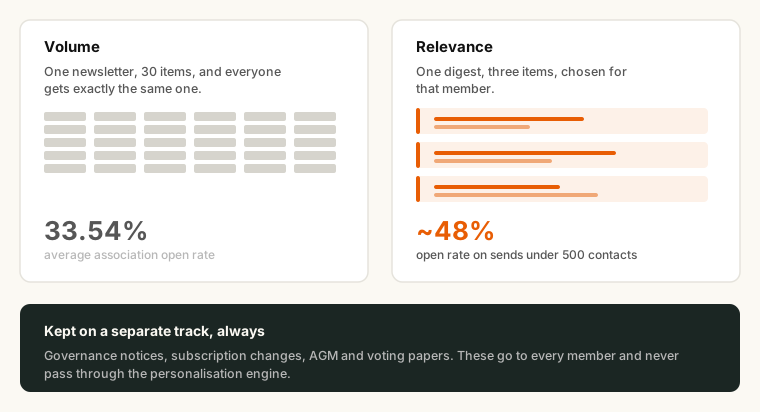
Higher Logic's 2025 to 2026 Association Email Benchmark Report, based on around 1,500 associations and nonprofits and more than two billion emails sent during 2025, puts the average association open rate at 33.54%. Higher Logic is a US platform, so read this as directional here rather than local. Two-thirds of your members don't open the newsletter you worked hard on. In the same research, 51% of members said they already receive too many messages, with 28% of those calling it "way too many".
So the instinct to send more is exactly backwards. This second post is about AI for association members: what lands in their inbox and what they meet when they log in. The most useful thing AI does on this side is make sure the small amount each member sees is the right content.
Relevance over volume
The benchmark data makes this point better than I can. In the same Higher Logic report, emails going to fewer than 500 contacts had open rates near 48% and click rates above 8%, and performance dropped away as list size grew. Automated, targeted campaigns beat one-off sends across both measures.
Some of that is selection effect rather than pure cause. Small segments tend to be your most engaged people, so the numbers flatter targeting a bit. But the direction is consistent and it matches what members say they want, which is enough to act on. A digest of three relevant items beats a newsletter of thirty.
Members are asking for this directly. In Higher Logic's 2025 Association Member Experience Report, surveying more than 500 members and prospective members in the US, 84% said a personalised experience matters enough to affect whether they renew. And for the nervous board member: 94% said they had no problem with AI being used for personalisation and support where there's human input and transparency.
That's a permission slip. Members want you to use AI openly and keep a person in charge.
What to build
- Personalised digests: match each member's interests, history and segment against your recent content, and assemble a "here are the three things for you this fortnight" email. The member gets relevance and you send fewer, better messages. The same matching should drive what they land on when they sign in, otherwise you've built relevance for the inbox and left the portal generic.
- Intent-based search of the resource library: the same technology as the first post in this series, pointed at members instead of staff. Someone asks a plain-language question and gets the right guideline, template or past webinar, even when their words don't match your titles.
- Member directory discovery: "find me other members working on the same problem in my region." Matching on meaning turns a static list into a reason to log in. In the portals we've built, the directory is one of the few features members use without being prompted, and it's usually the worst-served by keyword search.
- Benchmarking insights: if you collect survey or operational data from members, you can show each member where they sit against the anonymised cohort. This is a classic association value proposition that most teams never have the capacity to deliver by hand, and it's the one most likely to justify a subscription on its own.
The two questions your board will ask
Whatever platform you're on, these two come up. Better to have thought about them before someone raises them in a meeting.
"If we build this around one AI provider, are we stuck?" Provider pricing and terms change, and they change fast. The question is whether switching later means changing a setting or rebuilding a feature. This is one place where architecture differs. Open-source stacks like Drupal put a provider abstraction layer in between, so the site talks to Anthropic, OpenAI, Gemini or a model you host yourself through the same interface, and swapping is configuration. Plenty of SaaS platforms hard-wire one provider. Neither approach is wrong, but you should know which one you've bought.
"Where does our member data actually go?" There's a difference between member records sitting in a database you control under a permission model you set, and the same records sitting on a vendor's platform under their terms. Self-hosted platforms give you the first, which is most of the reason associations end up on them. Whichever you have, ask your provider in writing whether member data is used for model training, how long prompts are retained, and which country the processing happens in. If you're weighing this up more broadly, I've written about where to draw the line between what you rent and what you own.
Questions to ask your platform provider
- Can we segment communications by member interest, and how granular does it get?
- Does personalisation happen inside our system, or is member data sent to a third party to do it?
- Can a member opt out of AI-assisted personalisation and stay on standard communications?
- If we want to change AI provider in two years, is that a setting or a project?
- Can we export everything if we leave, including the personalisation data?
Where it falls over
Personalisation is only as good as the member data behind it. If your records are thin or three years out of date, the three relevant items will miss, and members notice a bad recommendation far more than they notice a good one. The fix is data hygiene, not better AI.
Relevance also doesn't arrive tuned. Semantic search works off a similarity threshold, and the default is rarely right for your content. Set it too high and members get nothing back. Set it too low and they get everything back with the useful document sitting at number nine. When I documented building this the working range was roughly 0.2 to 0.5, and finding your number means running real member questions through it and watching what comes back. Budget for that session, because a search that returns confident rubbish is worse than the keyword search you replaced.
Relevance engines also create filter bubbles. Left alone, they'll stop showing a member things they should see, like a governance notice or a subscription change. Keep essential all-member communications completely separate from the personalised digest. Not as a preference, as a rule.
And none of this means a general-purpose chatbot let loose on your members. That's a board decision, and the next post explains why the answer is usually "not yet".
What this costs
Start smaller than you think. If you have 800 members and five interest categories, rules-based segmentation gets you most of the way and needs no AI at all. Send two or three versions of the newsletter based on membership type and declared interests, see whether the numbers move, and only reach for AI once you have proof that relevance was the thing your members were missing. Plenty of associations buy the clever version before they've tested the obvious one.
Segmentation and targeted sending are within reach on nearly every membership platform sold today, and are often already in your plan. Semantic search over a document library needs a search index and carries an ongoing usage cost, which stays manageable at association scale.
The bigger investment is getting your content tagged and your member records tidy enough that relevance works at all. That's weeks of unglamorous work, and it's the part most projects underestimate. When we rebuilt NZSAE's member portal, the useful lesson was that you have to know what your members do before any of this personalises anything useful.
Next in the series
Next week, the last post is the governance one: what to say when a board member asks what your AI policy is, how the Privacy Act 2020 shapes the answer, and which controls make it more than a paper promise. As each part goes up it appears under Web for Associations.
If you'd like to talk through what this looks like for your association, get in touch.
Get the newsletter
Practical web and technology advice for associations, fortnightly. No spam, unsubscribe anytime.